.png?width=774&height=812&name=Master%20final%201%20(1).png)

Anand Parameswaran
Chief of AI & Transformation, Cyient
Across all industries, the pressure to “do something with AI” is now a constant feature of leadership conversations. Investments are being made, pilots are proliferating, and most organizations can point to a list of AI projects somewhere in the business.
Yet a recurring pattern has emerged: while pockets of innovation are visible, the underlying operating model – how work is planned, delivered, governed and resourced – often looks much the same as it did before. AI is present, but the operating system itself is largely unchanged.
For a company like Cyient, whose customers rely on delivery discipline in mission-critical, asset‑intensive environments, this gap is not academic. It goes to the heart of what Embracing Intelligence should mean in practice.
What Embracing Intelligence Means in Engineering-Led Sectors
In Cyient’s core industries, systems are governed by physics, regulation and safety requirements. Organizations cannot afford experimental operating models that work in slides but not in the real world. In this context, Embracing Intelligence cannot be reduced to “experiment with AI wherever possible” - it needs a more precise definition. At an industry level, three characteristics stand out:
- It is about problem-first, not tool-first
Instead of starting from “we must use this new model or platform”, Embracing Intelligence starts with a clearly defined outcome – for example, halving the concept-to-certification timeline for a new aero engine. Only then does it work backwards to which value streams and decisions must change, and what combination of human, domain and artificial intelligence is needed to achieve that outcome. - It requires value-stream thinking
In engineering-centered businesses, value doesn’t flow neatly along departmental lines. It runs across concept design, simulation, certification, supply chain, manufacturing and in-service support. Embracing Intelligence treats these as connected value streams rather than isolated functions, and asks where intelligence can remove friction or delay end-to-end. - It relies on human-plus-technology operating models
In safety-critical environments, engineering judgment remains non-negotiable. Embracing Intelligence assumes that AI will augment engineers – surfacing patterns, simulating options, scoring risk – while accountability for safety and ethics stays with people.
Embracing Intelligence for Business Performance: From Pilots to Operating System Change
If Embracing Intelligence is to move beyond language, it has to be visible in how organizations run their internal value streams. Let’s look at how a domain-first approach plays out in three core areas for an Engineering Services organization:
-
Delivery: Embracing Intelligence enables organizations to align internal improvements with customer outcomes
Efficiency programs often succeed on internal metrics but fail to change what customers experience. While cycle times or costs might be reduced, delays and friction can still reappear elsewhere along the chain. This isn’t just hypothetical. Studies are increasingly showing that, while agentic platforms are improving the individual productivity of software developers, overall enterprise productivity continues to struggle as bottlenecks are simply moved downstream.
With an intelligent operating system, organizations can better connect internal improvements directly to external outcomes by:-
Mapping how work, information and decisions move from opportunity identification to design, delivery and in‑service support.
-
Identifying where uncertainty on the critical path – for example, around dependencies, constraints or resource availability – can be reduced through AI‑driven forecasting, simulation and decision support.
-
Measuring impact in terms of time‑to‑value, earlier commissioning, reduced capex exposure and improved service levels, not just internal utilization or hours saved.
-
Our Delivery transformation is executed along two integrated “power pairs”:
-
-
The craft engine (engineering and product quality) – leveraging the evolving agentic tools in software development, mechanical design, and process engineering within a proprietary framework of product quality guardrails created from a digital catalog of our past experience.
-
The execution engine (workforce and process assurance) – combining agentic workflow tools with knowledge around specific assurance processes needed for specific industries, drastically reducing the time to market for our customers.
-
-
Recruitment: Embracing Intelligence reduces time‑to‑talent
For services organizations, the ability to mobilize the right talent at the right time is a critical path dependency. Traditional recruitment processes are often fragmented: requisitions move between sourcing, screening, interviewing and approvals with limited shared visibility, and with little explicit linkage to delivery commitments.
An operating model that truly embraces intelligence reimagines talent acquisition as an integrated value stream with zero friction. That means:-
Using data and AI‑assisted workflows to surface demand signals, create proactive candidate pipelines, and assess candidate fit, likelihood of offer acceptance and likelihood of success.
-
Automating low‑value steps such as initial screening and scheduling, freeing specialists to focus on judgment and candidate experience.
-
Connecting recruitment metrics in real-time to project and revenue milestones, so delays are understood in terms of business impact rather than just open headcount.
-
The result is not a “fully autonomous hiring engine”, but a more intelligent system that shortens time‑to‑talent while focusing human talent on the more critical aspects of decision making and candidate engagement.
-
Quality: Evolving from periodic inspection to continuous risk‑sensing
In most services organizations, quality is still governed by periodic reviews, audits and post‑fact inspection. The limitations of this model are well understood: issues are often discovered after cost and schedule impact has already been incurred. It’s the reality of using AI solely as a means of automation instead of integrating it in a way that reimagines processes and systems from the ground up.
When intelligence is applied and embedded in a more purposeful way, process assurance is transformed from a discrete, audit-driven exercise to an always-on practice that captures mistakes and omissions as they arise, flagging risks and providing solutions in real time. In practice, this could be the difference between catching non-compliance with traceability standards at the point of artifact creation, instead of waiting for a scheduled audit to identify the error weeks later.
Embracing Intelligence reframes quality as a continuous risk‑sensing system:
-
-
Aggregating data from delivery, test results, customer feedback and compliance into dynamic risk scores.
-
Directing expert attention to programs where the risk profile is deteriorating, rather than treating all work as equal.
-
Feeding insights back into standards, methods and training so that each incident improves the organization’s “pattern recognition”.
-
How We are Embracing Intelligence in Our Operating System Transformation and How This Changes The Way We Deliver Value for Clients
At Cyient we do not define ourselves as “AI‑first”. Instead, we see our role as helping customers embrace intelligence – human, domain and artificial – in ways that are contextual, responsible and engineered for the realities of the physical world.
The way we are transforming our operating system inside Cyient highlights that in three ways:
-
Rapid value validation and scaling
By applying Embracing Intelligence to all our own internal value streams, we demonstrate that the concept of Domain + AI is more than a marketing line. It is a lived discipline in how we run, evolve and ensure our business remains current and relevant. -
Pattern library for customers
Many of the challenges we face internally – scaling AI beyond pilots, connecting efficiency to customer value, protecting safety and quality – mirror those of our customers. The operating‑system changes we make can therefore be translated into reference patterns and frameworks for clients in aerospace, transportation, energy, telecom and manufacturing. -
Consistency of narrative and experiences
Whether it's halving cycle times by re-engineering value streams, or intelligent network modernization rather than AI-first claims, we are always expressing the same underlying idea: intelligence should be applied in context, in service of reliability, resilience and value.
For engineering-led organizations, the next wave of advantage will not be defined by how many AI pilots they can list, but by how quickly and thoughtfully they can transform their operating systems.
Embracing Intelligence, in terms of AI and Delivery, is about moving from scattered projects to value‑stream level change: shortening time‑to‑talent, turning quality into continuous risk-sensing, and ensuring delivery improvements show up as earlier, safer value for customers.
When that shift happens, intelligence ceases to be a series of experiments and becomes part of how the organization works. This is the transition that I am focused on at Cyient – and the standard against which we will measure our own progress, as well as that of our customers.
Leading the AI-Powered Evolution in Healthcare
At Cyient, we’re helping healthcare and life sciences organizations move from digital to intelligent, where AI amplifies human ingenuity and engineering precision. By combining deep domain expertise with advanced technology and data science, we turn algorithms into insights, and insights into measurable impact.
This is how being Domain-First, Tech-Driven, and AI-Infused creates enduring differentiation.
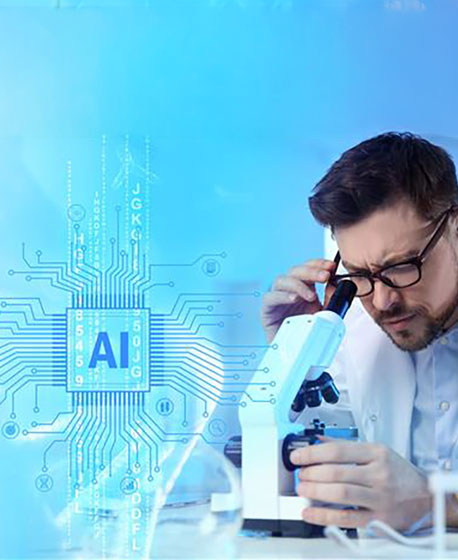
AI-Driven
Product Design
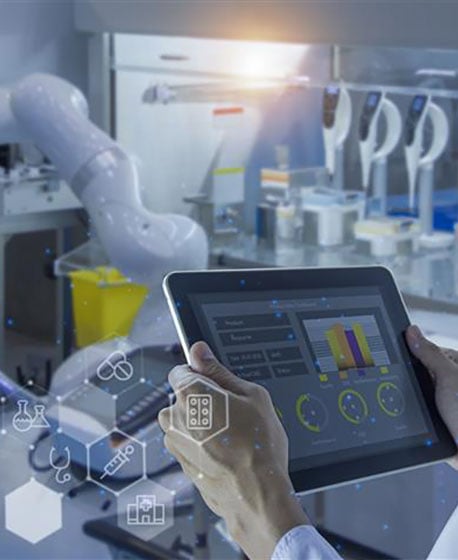
Smart
Manufacturing

Connected
Health Ecosystems

Regulatory &
Quality Intelligence