

What AI can change is clear.
Yet, what changes… needs human judgment
In sectors where assets last decades, the key is not deploying another model but understanding how intelligence, people and economics interact across the system
In just 12 months, I have seen the conversation around AI shift beyond recognition. What started with model announcements and benchmarks quickly shifted to deployment: copilots, workflow tools, industry solutions and partnerships, all built to move AI from pilot to production. Competition was graded on capability and implementation. But today, that’s no longer where the advantage lies. We’re entering a third phase that I think will change the terms of competition entirely.
A new kind of AI services proposition has started to emerge: one that sits closer to the client’s workflow, shapes where AI should be applied, and guides adoption upstream rather than simply implementing downstream.
The market is maturing. However, this exposes more fundamental questions: where should intelligence actually lead? What does that mean for the people who carry the consequences. And importantly, do the economics justify the change at all?
From what I’m seeing, it’s those three areas: systems, people and economics, that will dictate precisely how and where AI is embedded over the next few years.
Systems impact: the path to outcomes
In many enterprise environments, the biggest challenge isn’t deploying AI once a use case has been chosen. It’s understanding the workflow well enough to know where AI belongs, what kind of intelligence should lead, and whether the change is worth making in the first place.
For too long, the conversation has run on a narrow assumption that services firms offer a menu of AI use cases, enterprises pick from it, and implementation follows. Sometimes that is true, but it ignores the bigger picture. What many enterprises need is a partner who can study the system in context, see how work really flows, identify where intelligence can improve outcomes, and then decide what should change, what should not, and in what order.
Historically, that work has always belonged more to management consulting than to classic IT services. What’s changing is that model providers are now clearly trying to move into that space as well. And it’s easy to see why. If AI becomes central to how enterprises operate, the most valuable position is not to supply the model or even implement it, but to be the one defining the workflow itself.
This is where the prevailing narratives break down for an engineering-led business like ours. First of all, they often assume our industry is built on coding. It is not. Coding matters, of course, and in many contexts it’s essential. But in the environments Cyient works in, it’s only part of the work. A great deal of value sits elsewhere: in systems engineering, architecture, compliance, validation, integrations, operations knowledge, certification and lifecycle judgment. Even in software-intensive sectors, most outsource engineering is not writing code. It’s deciding what should be built, how it fits into a larger system, how it will be validated, and what consequences it creates downstream.
This is also why I don’t like to consider AI a “tool” — at least not in the traditional sense. Few technologies up to now have been able to improve themselves, generate new artefacts, reshape workflows and shift the economics of expertise at this pace. That doesn’t mean AI should be mystified, but it does mean we shouldn’t limit it to just another ‘implement’ in the engineering toolkit. It is better understood as a new class of capability: one that demands governance, context and accountability, but also changes the system around it.
From a leadership perspective, this brings us to another hurdle: how do you adapt to a form of intelligence that keeps improving, while staying grounded in domain knowledge, human judgment and economic discipline? In consequence-critical sectors, this is where independent, domain-led partners are needed, helping clients arbitrate between models, vendors and economics.
At Cyient, we approach this from the realities of aerospace, rail, energy, utilities, connectivity, mining and manufacturing, where assets last decades, decisions have very real consequences, and value spans the whole lifecycle. In those worlds, someone still must certify with judgment:
- Which model is more appropriate for this task?
- Where must human authority stay primary?
- What is the consequence of error?
- What will the impact of this decision be three years from now, not just three months?
- And importantly, is this even the right problem to solve?
These questions reframe how we approach AI, taking time to understand how and where to layer it on top of domain knowledge and human expertise in a way that makes us more integrated, relevant and valuable to our customers over time.
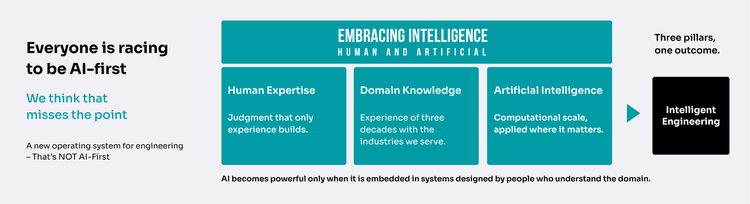
This is something we are deeply committed to at Cyient. In November 2025, I introduced this as a concept that we like to call Embracing Intelligence: a way of working based on human expertise, domain knowledge and artificial intelligence each having a role to play. And since then, we have been formalizing this with our Intelligence Operating System. Not a slogan or a product, but a discipline that puts Embracing Intelligence to practice.
It begins with framing: defining the system, constraints and value drivers before any model or platform is chosen. It then moves to selection: deciding which intelligence should lead in a given context. Then comes assurance: validating outputs against physical constraints, standards and regulations, always with human authority at the core. And finally, there is evolution: where intelligence compounds as teams learn from deployment, models improve, workflows are redesigned, and lessons from one phase of the lifecycle inform the next.
This framework dictates how we design and implement solutions across industries. But importantly, it also changes how we think about productivity and talent.
People impact: the future of talent
Since the emergence of AI, there’s been a lot of talk about what the future talent model will look like. Some think the shift will be as simple as from a pyramid to a diamond structure, but in practice, I expect something closer to an hourglass, varying by context.
At the top, experienced people will remain critical for framing problems, exercising judgment and defining what ‘good’ actually looks like. At the entry level, people early in their careers will be able to produce work that once demanded far more experience because they will be partnered with AI. It’s the middle where things might look a little different. But the result isn’t simply “fewer entry-level roles”. It’s more that the mix of work and metrics change, and the speed of adaptation will have to increase – meaning the organizations that stand out will be those that treat adaptability itself as a core capability, not a side effect of technology projects.
This is where the human element of our Intelligence Operating System becomes critical. While a model may be brilliant at summarizing, simulating or recommending, in consequence-critical work human authority and expertise must lead. AI doesn’t sign off on its own. Accountability belongs to the engineers and domain experts who live with the outcome.
For us, the point of partnering people with AI is always to move human judgment to where it matters most.
Economic impact: weighing up the cost
Which brings us to the discipline that decides whether any of it is even worth doing. Over the last year, model performance has improved, even as token and infrastructure costs have started to fall. But lower unit costs on their own do not add up to a business case. A use case can be technically sound and still be the wrong answer if the economics don’t work in context. Economic discipline should sit alongside domain knowledge and human judgment as a condition for adoption, always asking: is this change solving the right problem, and does it justify itself?
We see this constantly. In mining, the right AI-enabled intervention can lift throughput and energy efficiency, but only when it’s grounded in process knowledge, operator reality and clear ROI logic. In rail, AI can strengthen compliance and cut operational error, yet a technically viable system can still be the wrong call if the numbers don't hold.
In both cases, the value comes from applying intelligence responsibly within the system and being transparent about cost and return before committing. That lens has to stretch across the entire lifecycle: how a decision affects operations, compliance, uptime, maintenance, sustainability and end-of-life cost. And it is precisely why, in our world, having a deep and informed understanding of the full lifecycle matters far more than any single implementation.
Why judgment will matter more than implementation
The shift is hard to ignore. The services landscape is changing, business models will change with it, and firms like ours will need more IP, deeper domain expertise, new talent structures and new measures of productivity. But the enduring source of value will steer increasingly away from use case catalogues and one-model ecosystems. Instead, it will be the ability to understand a client’s domain deeply enough to shape the workflow, apply the right intelligence at the right point, and stay accountable for outcomes over time.
That is a higher bar than implementation, and a far more durable one.
I’m a firm believer that the strongest companies in our sector will be the ones that know how and where to layer AI and digital on top of deep domain knowledge and human expertise in ways that directly improve outcomes for the people who rely on them. Yes, they will adapt fast. But perhaps more importantly, they will think in systems, connecting strategy to execution, design to operation, and innovation to responsibility.
That’s the future I see for this industry. And it’s the discipline we are building into the way Cyient shows up for its customers.