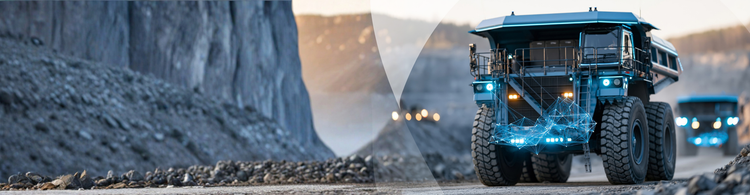
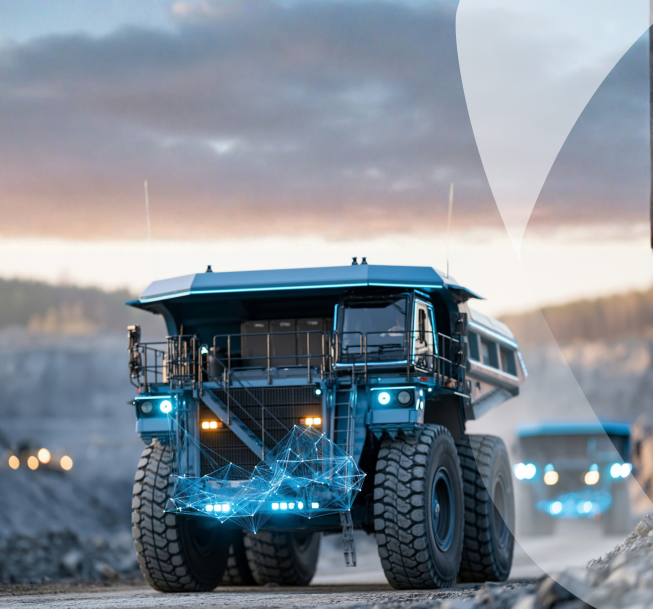
Stand at the edge of a quarry for ten minutes and you’ll understand why off-highway autonomy is a different problem from highway autonomy. There are no lane markings. The “road” changes shape every hour as material is moved. Dust hangs in the air. The machine is vibrating hard enough to shake a sensor mount out of calibration, and the temperature inside the cab would be considered a fault condition in most electronics labs.
Now add the part that gets overlooked in most conversations about AI in machines: many of these sites are remote, and connectivity can’t be assumed. And even when it is, the physics of latency mean the cloud is simply too far away to help.
An autonomous wheel loader that detects a person stepping into its path cannot afford a round trip to a data center before it decides to stop. Neither can a firefighting robot approaching a hazardous zone, or a crane positioning a load with people working below. The decision has to happen where the machine is, in a loop measured in milliseconds, every single time, not most of the time.
That is the case for on-device intelligence. And it’s why I believe edge-first Physical AI is what turns field autonomy from a demonstration into something a customer can actually deploy.
Why edge intelligence is hard and why connectivity is only part of the challenge
Connectivity in these regions is the reason everyone cites. This is rarely the hardest part.
The harder constraints are the ones that come with putting intelligence inside a machine that has to do real work. Real-time motor control demands deterministic loops, not “fast on average,” but bounded, predictable, and provable. Dexterity and end-effector precision require perception and control to stay tightly coupled, because a few milliseconds of lag becomes a few centimeters of error at the tool tip. Sensor fusion has to hold up when a camera is half-blinded by dust and a radar return is noisy from vibration, which means the fused view has to degrade gracefully rather than fail outright.
All of this has to run on constrained hardware, inside a thermal and power envelope set by the machine, not by the algorithm.
And there is one more constraint that I think is a feature rather than a limitation: not every decision should be automated. Judgment calls such as an unfamiliar obstacle, an ambiguous scene, a task with consequences, belong with a human. Designing deliberately for a human in the loop is what makes autonomy deployable in environments where the cost of being wrong is measured in lives, not downtime.
Sense, think, act: as one continuum
Physical AI isn’t traditional AI, generative AI, or vision AI on their own. It’s the embodiment of intelligence in the physical world through an integrated Sense–Think–Act pipeline, where each stage constrains the next.
| Stage | What it does on-device |
| Sense | Multi-modal perception across camera, LiDAR, radar and IMU, sensor fusion and calibration, object detection and tracking, localization and mapping, scene understanding. |
| Think | VLMs, VLAs, edge LLMs and spatial reasoning driving task and motion planning, behavior prediction, and safety and risk assessment. |
| Act | High-precision actuation with continuous feedback — kinematics and dynamics, manipulation and grasping, real-time execution on ROS 2 and RTOS. |
The reason we treat this as one continuum rather than three modules is that off-highway environments punish handoffs. Perception that’s accurate but slow is useless to a controller with a fixed cycle time. A planner that reasons beautifully but can’t express its intent as a safe trajectory doesn’t move the machine.
What we’ve actually built
Our Physical AI work spans that full continuum, and it’s grounded in perception work already proven in the field.
On the Sense side, we’ve delivered sensor fusion combining camera and radar for correlated detections in surround-view and collision warning, 360° bird’s-eye view from multi-camera rigs built for off-highway and construction environments, and customizable ADAS stacks portable across NVIDIA, NXP and Qualcomm platforms. For a European off-highway OEM, we developed an end-to-end perception system for wheel loaders which includes EE architecture, sensor selection and positioning, calibration, fusion algorithms and safety analysis, giving operators a 360° view of their environment and contributing to a significant reduction in HMI incidents.
Alongside that sits newer reasoning and action engagements: VLM-based contextual intelligence, VLA-driven pick-and-place robotics, and autonomous path planning, plus next-generation display, telematics and instrument cluster work for the operator-facing side of the machine.
Underneath all of it are software building blocks designed to be modular, optimized and hardware-agnostic, running on NVIDIA, Qualcomm and NXP silicon, with CARLA and ISAAC for simulation and Sim2Real workflows.
Why hardware-agnostic matters more than it sounds
“Hardware-agnostic” reads like an architecture preference. In off-highway, it’s a commercial one.
Machine programs run for years. Silicon roadmaps don’t. An OEM that ties its perception stack to one accelerator inherits a rewrite every time compute changes, or every time a different machine family needs a different power envelope. Building component-based, independently updatable modules with one codebase, multiple deployment targets, minimal porting effort is what lets a customer reuse a perception foundation across vehicle programs instead of rebuilding it.
The same logic applies to footprint. Minimal memory and processing requirements aren’t an engineering vanity metric; they’re what makes low-latency, real-time performance achievable on the compute a machine can actually carry and cool.
Designed for production, not for the demo floor
There’s a version of Physical AI that looks spectacular in a video and never survives contact with a job site. The difference usually comes down to what was assumed at the start.
We take a simulation-led approach, so that rare and dangerous scenarios can be explored before a machine ever moves. We build with functional safety and cybersecurity as design inputs rather than late-stage audits. And we validate through MIL, SIL and HIL, because an autonomy claim you can’t test repeatably isn’t a claim you can ship.
That discipline is not new for us. It comes from more than 30 years of experience and the expertise of over 3,600 engineers working across automotive and off-highway programs where safety cases, not demos, decide whether something goes into the field.
The bigger picture
The machines that reshape construction sites, mines, farms and emergency response over the next decade won’t be defined by how much intelligence sits in the cloud. They’ll be defined by how much useful intelligence fits inside the machine and how reliably it behaves when conditions are at their worst. This is where Cyient is developing Software IPs, building reusable, hardware-agnostic Physical AI components rather than one-off integrations.
That’s the work: perception that holds up through dust and vibration, reasoning that knows when to defer to a person, and control loops that are deterministic because lives depend on them being so. Getting that right is less glamorous than the demo reel. It’s also the only thing that makes field autonomy real.